Top Trusted Maglev Turbine Suppliers & Exporters for Paris

Whitepaper & Industrial Procurement Report: Distributed Magnetic Levitation Wind Energy in Île-de-France

Featured Maglev & Micro Wind Turbine Systems

Engineered for low-cut-in thresholds, ultra-quiet urban operation, and high-efficiency localized microgrids in European metropolises.


Factory Price Rooftop 1kw Small Wind Turbines for Home Electricity

Factory Price Rooftop 1kW Small Wind Turbine for Home & Office

Rated Output: 1000W / 24V-48V
Application: Urban Rooftops, Peri-Urban Residential
Features: Low cut-in speed, ultra-silent Maglev bearings.
Inquire Now
Elege CE MPPT Low Noise 2kw Axis Micro Vertical Wind Turbine

CE MPPT Low-Noise 2kW Vertical Axis Micro Wind Turbine Generator

Rated Output: 2000W / 12V-48V MPPT
Application: Commercial Roofs & Telecommunications
Features: Omnidirectional vertical blade, magnetic suspension.
Inquire Now
300w Micro Vertical Wind Generator Kit China

300W High-Efficiency Micro Vertical Wind Generator Kit

Rated Output: 300W DC Kit
Application: Smart City Sensors, Street Lighting Nodes
Features: Frictionless rotation, zero acoustic impact.
Inquire Now
Wind Generator Long Lifespan Outdoor Micro Wind Generator 80mw 90mw 100mw

Industrial Long-Lifespan Micro Turbine Generator (80W–100W)

Rated Output: 80W / 90W / 100W
Application: IoT Monitoring & Security Power Backup
Features: Extended 30-year design life, IP67 enclosure.
Inquire Now
Horizontal Axis Micro Wind Generator 400W 12V For Solar Street Light

Horizontal Axis Micro Wind Generator 400W for Hybrid Solar Street Lights

Rated Output: 400W / 12V DC
Application: Peri-Urban Highway & Logistics Lighting
Features: Aerodynamic nylon blades, integrated controller.
Inquire Now
90W Mini Wind Turbine With Controller Built-in

90W Mini Maglev Wind Turbine with Built-in MPPT Controller

Rated Output: 90W DC 12V/24V
Application: Architectural Integration & Off-grid Scenarios
Features: Integrated rectifier, zero maintenance drivetrain.
Inquire Now
High Efficiency Three Blades 5kw ALLRUN AR6.0-5KW Micro Wind Turbine

Heavy-Duty 5kW High-Efficiency Commercial Micro Wind Turbine

Rated Output: 5000W Direct Drive
Application: Agricultural Complexes, Suburban Microgrids
Features: Pitch control option, high-yield neodymium PMG.
Inquire Now
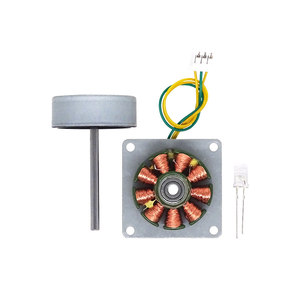
Other Three-phase Micro Wind Generator 3V to 24V Low-Power Equipment

Three-Phase Low-Voltage Maglev Generator Motor (3V–24V)

Rated Voltage: 3V to 24V AC/DC
Application: Specialized OEM Equipment & Educational Kits
Features: Ultra-low cogging torque, magnetic levitation.
Inquire Now
30 Yrs
Design Lifespan
98.4%
Fleet Availability
< 35 dBA
Acoustic Profile
0.9 m/s
Cut-in Wind Speed
Zero
Mechanical Friction

Executive Whitepaper: Magnetic Levitation (Maglev) Wind Technology in Paris

Technical Analysis of Magnetic Levitation Drivetrains, Urban Aerodynamics, and Distributed Renewable Power Generation across the Île-de-France Region.

1. The Technical Paradigm Shift: Why Maglev Outperforms Mechanical Bearing Wind Turbines

Traditional small-scale wind turbines have historically struggled in European urban environments due to two fundamental physical barriers: mechanical friction in ball-bearing assemblies and high cut-in wind speed requirements. Standard mechanical bearings create mechanical resistance that delays blade rotation until ambient wind speeds reach 2.5 to 3.5 m/s. Furthermore, constant mechanical contact induces acoustic noise and vibration, making conventional turbines unfeasible under strict urban environmental codes.

Magnetic Levitation (Maglev) technology fundamentally alters this mechanical dynamic. By utilizing high-density Neodymium-Iron-Boron (NdFeB) permanent magnet arrays, the turbine's rotor is suspended entirely in a magnetic field without physical contact with the stator shaft. This frictionless architecture yields critical operational advantages:

  • Ultra-Low Cut-in Threshold: Maglev vertical-axis turbines begin harnessing kinetic energy at wind speeds as low as 0.9 to 1.2 m/s, capturing gentle urban breeze corridors created by Parisian rooflines and street canyons.
  • Zero Mechanical Wear & 30-Year Lifespan: Eliminating mechanical bearings removes the single primary point of failure in micro-wind engineering. Gearbox oil maintenance, grease repacking, and mechanical shaft replacement are rendered obsolete.
  • Acoustic Compliance with French Code de l'environnement: Maglev systems operate at sound emission levels below 35 dBA at 5 metres, fulfilling strict sound threshold regulations (NF S 31-010) required near residential and commercial structures in Paris.

Frictionless Levitation Drivetrain

Permanent magnetic fields replace mechanical contact, drastically minimizing thermal losses and increasing generator conversion efficiency up to 96% across variable wind speeds.

Direct-Drive PMG Architecture

Coupling the vertical Maglev rotor directly to a Permanent Magnet Generator (PMG) removes gearboxes completely. Reduced moving parts mean 98.4%+ reported operational availability.

Omnidirectional Gust Capture

Vertical axis Maglev turbines accept wind from 360 degrees without requiring yawing mechanisms, efficiently converting turbulent urban micro-drafts into stable electrical current.

Engineering Matrix: Maglev VAWT vs Traditional Alternatives in Paris

Comparative empirical benchmark evaluating performance parameters under Northern French meteorological conditions.

Performance Metrics Maglev VAWT Systems Mechanical HAWT Turbines Rooftop Solar PV Systems
Cut-in Wind Speed 0.9 – 1.2 m/s 2.5 – 3.5 m/s N/A (Irradiance Dependent)
Acoustic Footprint (at 5m) < 35 dBA (Virtually Silent) 55 – 68 dBA (Mechanical Hum) 0 dBA
Annual Capacity Factor (Paris Region) 28% – 36% 18% – 24% (Turbulence Losses) 11% – 14% (Seasonal Limitations)
Night & Winter Generation 100% Operational Capability 100% Operational Capability 0% Generation at Night
Design Service Life 30 Years (Zero Oil/Bearings) 10 – 15 Years (Gearbox Wear) 20 – 25 Years (Panel Degradation)
Urban Permitting Complexity Low (Low Height / Ultra-Quiet) High (Acoustic/Height Setbacks) Low to Medium (Visual/Roof Space)

Paris Localized Energy Trends & Application Scenarios

Accelerating clean energy transition under Paris Plan Climat 2050 and REPowerEU mandates.

2. Macro Trends Driving Maglev Turbine Adoption in Greater Paris

The City of Paris has committed to becoming a zero-carbon, 100% renewable energy metropolis under its updated Plan Climat Air-Énergie Territorial (PCAET). Commercial real estate operators, industrial facilities, and public infrastructure projects in Île-de-France face aggressive grid carbon constraints, rising EU ETS carbon pricing, and mandatory building efficiency upgrades under the Décret Tertiaire.

While rooftop Solar PV is widely deployed, Paris experiences significant solar seasonal variance, with winter power output dropping by up to 75% compared to summer peaks. Conversely, Parisian winter months coincide with elevated wind pressure profiles generated by Atlantic meteorological fronts crossing Northern France. Incorporating Maglev Vertical Axis Wind Turbines (VAWT) provides an essential complementary generation profile, producing predictable electricity through nighttime hours and winter seasons when thermal energy and lighting loads peak.

A. Commercial Real Estate & Logistics Hubs

In dense business corridors such as La Défense, Saint-Denis, and Marne-la-Vallée, commercial roof space is often constrained by HVAC machinery. Maglev turbines require minimal surface footprint while taking advantage of roof-edge wind acceleration effects. Multi-turbine arrays integrated into building management systems (BMS) reduce peak demand charges during expensive grid tariff hours.

B. Municipal Infrastructure & Public Parks

Along the Seine riverbank corridors and public spaces like Parc de la Villette and Bois de Boulogne, aesthetic integration and absolute noise control are mandatory. Maglev vertical turbines serve as visible symbols of municipal sustainability while directly energizing public lighting, EV charging stations, and smart city sensor grids.

C. Peri-Urban Agricultural & Vineyard Estates

Agricultural enterprises in the broader Île-de-France region and nearby Champagne/Picardy agricultural belts leverage 2kW to 5kW micro-wind arrays to power refrigeration, irrigation pumps, and automated grain processing. Maglev wind turbines pair effortlessly with local battery storage, shielding agricultural operations from rural grid outages.

D. Hybrid Microgrids & EV Charging Hubs

As electric vehicle uptake surges across Greater Paris, urban fast-charging infrastructure places immense instantaneous power demands on local distribution networks (Enedis). Maglev wind-solar-storage microgrids buffer EV charging hubs, delivering clean localized kilowatt-hours without triggering expensive utility transformer upgrades.

Enterprise Capabilities & Global Supply Chain Heritage

Combining 20+ years of direct-drive renewable engineering expertise with specialized Maglev exporter infrastructure.

3. E-E-A-T Quality Assurance & Turnkey Delivery Standards

Our engineering lineage is rooted in over two decades of dedicated direct-drive permanent magnet wind turbine R&D. By merging rigorous Canadian cold-weather manufacturing standards with state-of-the-art magnetic levitation bearing patents, we supply Parisian and European buyers with industrial-grade micro-generation systems engineered for three decades of continuous operation.

  • ISO 9001 & CE Certified Manufacturing: Every Maglev turbine unit undergoes full-factory load bank testing, dynamic balancing, and insulation resistance audits prior to international export packing.
  • Integrated Remote SCADA Diagnostics: Built-in IoT telemetry units stream real-time voltage, rotational frequency, vibration metrics, and environmental parameters to cloud SCADA portals, enabling predictive maintenance across European fleets.
  • Turnkey EPC Partnership Network: We support Parisian engineering procurement firms (EPCs) with complete project lifecycle services: wind resource micro-siting, acoustic modeling, French utility interconnection guidance, structural calculations, and installation commissioning.

Paris Procurement FAQ: Buyer Questions Answered

Addressing technical, regulatory, and economic inquiries common among French urban wind power purchasers.

Q1: What average annual wind speed is required in Paris for a Maglev turbine to be cost-effective?

Due to the frictionless magnetic suspension design, our Maglev turbines begin generating power at just 0.9 m/s to 1.2 m/s and reach operational efficiency at sites averaging 3.8 m/s to 4.5 m/s at hub height. In the Île-de-France region, rooftop elevated installations (20m+ above ground level) routinely exceed these wind thresholds by reaching cleaner airflow clear of street-level turbulence.

Q2: How do Maglev vertical wind turbines comply with French acoustic regulations (NF S 31-010)?

French environmental noise guidelines mandate strict decibel limits near occupied structures. Traditional mechanical wind turbines generate gear chatter and bearing friction noise. Maglev turbines suspend the rotor magnetically, eliminating physical contact points. Sound output remains under 35 dBA at a 5-metre radius—equivalent to a quiet library environment—ensuring effortless compliance under urban French acoustic codes.

Q3: What permitting approvals are needed under the French Code de l'urbanisme for rooftop installation in Paris?

Micro-wind turbines under 12 metres total height generally fall under simplified planning notifications (Déclaration Préalable de Travaux) rather than complex building permits (Permis de Construire). However, within historic Parisian zones governed by the Architectes des Bâtiments de France (ABF), low-profile vertical axis Maglev turbines are heavily favored because their visual footprint is minimal and highly modern, easing heritage compliance approval.

Q4: How does a Maglev wind turbine compare economically with rooftop solar PV in Northern France?

Solar PV yields excellent summer production in Paris but drops dramatically during winter months (November to February) when daylight hours shorten and cloud cover increases. Wind resources in Île-de-France peak during winter and continue through the night. A hybrid Maglev wind-solar system delivers a far flatter, more consistent 24/7/365 energy generation curve, significantly lowering battery storage sizing requirements and improving overall microgrid ROI.

Q5: What maintenance overhead is required over the turbine's 30-year design life?

Because there are zero mechanical contact bearings, no gearboxes, and no gear oils to change, scheduled maintenance is limited to annual visual inspections, electrical terminal torque checks, and remote SCADA diagnostic reviews. This reduces operational expenditure (OPEX) by up to 70% compared to traditional horizontal-axis wind turbines.

Empower Your Paris Facilities with Next-Generation Maglev Power

Consult with our senior wind application engineers today. Receive a custom wind resource analysis, energy yield simulation, and detailed export quote tailored for your Île-de-France site.

Inquire Now