Technical Knowledge Base
Frequently Asked Questions for Procurement Engineers & Specifiers
Everything you need to know regarding meter selection, CT ratio matching, protocol integration, and factory quality assurance.
Q1: What is the difference between Class 1.0 and Class 0.5S energy metering accuracy standards?
Class 1.0 meters allow a maximum error margin of ±1.0% across the full active energy measurement range. Class 0.5S meters (governed by IEC 62053-22) are specialized revenue-grade meters with a maximum error margin of only ±0.5%. The "S" designation signifies that the meter maintains ultra-high precision even under extremely low load conditions (down to 1% to 5% of nominal rated current). Class 0.5S is strongly recommended for enterprise tenant submetering and heavy industrial circuit monitoring where slight measurement variances equal thousands of dollars annually.
Q2: How do RS485 Modbus RTU and Modbus TCP differ in industrial energy management applications?
RS485 Modbus RTU utilizes a serial 2-wire daisy-chain topology suitable for long-distance field bus wiring (up to 1200 meters) connecting up to 32 meters per gateway loop at lower hardware cost. Modbus TCP runs over standard Ethernet IP networks (RJ45), offering significantly higher data transfer speeds, sub-second polling frequencies, and direct integration into existing enterprise IT LANs without requiring serial-to-ethernet converters.
Q3: Can these smart energy meters be integrated into third-party IoT software like Energy Star Portfolio Manager, Tridium Niagara, or custom SCADA?
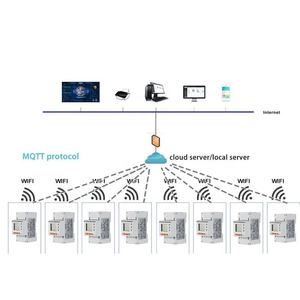
Yes. Our entire metering hardware lineup adheres to open industrial standards. We provide comprehensive Modbus register maps, JSON payload schemas for MQTT transmission, and RESTful API endpoints. This enables seamless connection to Tridium Niagara, Schneider PowerLogic, Siemens Desigo CC, AWS IoT Core, or customized enterprise EMS dashboards.
Q4: What current transformers (CTs) should be specified for high-current industrial switchgear panels?
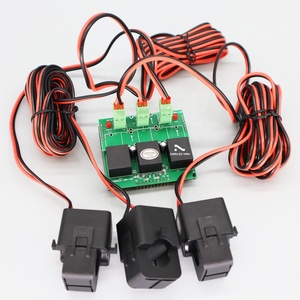
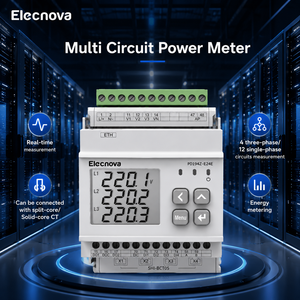
For retrofitting existing electrical panels without disconnecting busbars, Split-Core CTs (0-5A, 0-1A secondary or 333mV voltage-output CTs) are ideal. For new panel assemblies, Solid-Core CTs offer superior accuracy and lower phase shift error. Our energy meters feature programmable CT ratios directly configurable via the front keypad, Modbus software, or mobile application.
Q5: How does real-time power quality harmonics monitoring protect factory electrical assets?
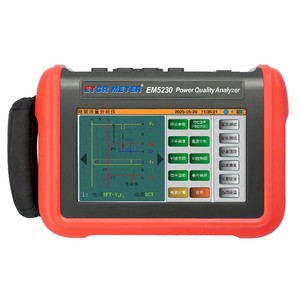
Non-linear industrial loads such as Variable Frequency Drives (VFDs), LED lighting drivers, arc furnaces, and switching power supplies inject harmonic currents into the power grid. High Total Harmonic Distortion (THD) leads to transformer overheating, nuisance breaker tripping, capacitor bank destruction, and motor insulation failure. Our 4-channel power quality loggers capture individual harmonics up to the 51st order, empowering engineers to install targeted active harmonic filters before catastrophic failure occurs.
Q6: What factory quality control and calibration procedures ensure long-term reliability?
Every manufactured metering unit undergoes automated 100% full-load and light-load calibration on high-precision test benches traceable to international standards (NIST / NIM). Printed circuit boards undergo automated optical inspection (AOI), conformal coating for humidity resistance, and a 72-hour elevated-temperature burn-in test under full operational load before final enclosure assembly.