Engineered for microgrids, residential installations, commercial systems, and severe weather environments. Fully customizable stator windings, shaft configurations, and mounting interfaces.







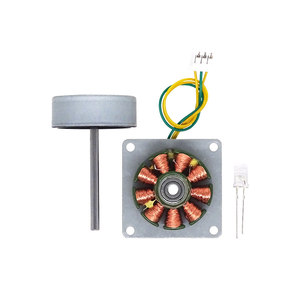
Since 2001, our engineering team has eliminated mechanical vulnerabilities in turbine power generation by mastering gearless Permanent Magnet Synchronous Generator (PMSG) designs.
By eliminating high-wear mechanical gearboxes and gear oil requirements, our alternators achieve maximum energy conversion efficiency while reducing routine maintenance intervals to once-a-year optical inspections.
Utilizing advanced electromagnetic slot-skewing algorithms and precision rotor magnet positioning, our alternators achieve ultra-low start-up torque, enabling energy capture at wind speeds as low as 2.0 m/s.
Every OEM alternator frame undergoes Vacuum Pressure Impregnation (VPI) Class-H insulation treatment and multi-layer C5-M anti-corrosion coating, making them suitable for coastal, offshore, and Arctic deployments.
We work directly with renewable energy manufacturers, project developers, and system integrators to supply custom voltage curves (AC 12V to 400V 3-phase), customized shaft keys, and specialized mounting flanges.
A deep dive into electromagnetic architecture, thermal management, and power curve optimization for next-generation OEM wind turbine integration.
In distributed wind energy and microgrid applications, the choice of alternator stator topology dictates overall system efficiency and lifecycle stability. Modern high-performance Permanent Magnet Synchronous Generators (PMSGs) utilize ultra-thin, high-grade silicon steel laminations (0.35mm thickness) to suppress eddy current losses during high-frequency rotation.
Furthermore, standard high-rpm alternators often suffer from excessive iron losses and magnetic saturation when retrofitted into direct-drive wind systems. OEM direct-drive solutions overcome this bottleneck by increasing the total pole-pair count (e.g., 12 to 48 poles). This multi-pole arrangement enables nominal power generation at low shaft speeds (50 RPM to 400 RPM), completely obviating the need for step-up gearboxes.
| Engineering Specification | Standard Commercial Alternator | Eocycle OEM Direct-Drive PMSG | Advantage Gain |
|---|---|---|---|
| Drivetrain Mechanism | Geared (Step-up ratio 1:10) | Gearless Direct-Drive | Zero gear oil changes, +15% net annual energy yield |
| Magnet Material Grade | Standard Ferrite / N35 NdFeB | High-Temp N45SH / N52H NdFeB | Resists thermal demagnetization up to 150°C continuous |
| Insulation Rating | Class B / Class F (130°C - 155°C) | Class H VPI (180°C Rated) | Surge protection against transient grid overload |
| Cogging Torque Ratio | > 4.5% Nominal Torque | < 0.8% Nominal Torque | Ultra-low cut-in speed starting at 1.8 - 2.2 m/s wind |
| Frame Protection Coating | Standard Powder Spray (C2) | C5-M Offshore Marine Grade | 15+ year resistance against salt-fog and acid rain |
One of the critical failure modes in custom turbine alternators is reversible or irreversible thermal demagnetization of rare-earth magnets under sustained overload conditions. When an alternator operates under peak current demand—such as during high-wind gusts or sudden battery charging surges—the stator windings generate significant internal resistive heating.
To preserve magnetic flux density over a 30-year operational life, our custom OEM alternators integrate dysprosium-doped Sintered NdFeB magnets with coercive force ratings ($H_{cj}$) exceeding 21 kOe. In addition, structural housing enclosures feature radial thermal dissipation fins paired with internal conductive potting resins to rapidly transfer thermal energy away from the active copper air-gap.
How global supply chains, decentralized microgrids, and hybrid energy storage are redefining specifications for wind turbine alternators.
Procurement teams are shifting away from fixed-frequency AC alternators toward wide-range, variable-frequency 3-phase AC outputs optimized for active rectification. Modern microgrids aggregate wind, rooftop solar, and lithium battery banks onto a central DC bus (48V, 380V, or 700V DC). OEM alternators are now custom-wound with flexible inductance parameters to maximize conversion efficiency across variable rotor speeds.
Industrial B2B buyers no longer buy stand-alone electrical machinery. Next-generation alternator procurement mandates embedded sensor suites—including digital vibration transducers, real-time stator temperature sensors (PT100/PT1000), and bearing condition monitors. This data feeds cloud-based predictive maintenance algorithms, achieving fleet availability rates above 98%.
To eliminate tariff risks and long project lead times, project engineering firms require OEM suppliers capable of delivering standardized internal magnet rotors paired with modular external mounting hubs. Standardizing internal stator laminations while allowing modular shaft and flange customization drastically reduces prototype turnaround times from 6 months down to under 4 weeks.
Whether offseting peak utility tariffs for intensive feeding operations or providing resilient power to islanded microgrids, direct-drive alternators offer superior ROI.


Essential technical and commercial answers for system integrators, wind developer procurement officers, and engineering contractors.
From initial electromagnetic FEA simulation to rapid prototyping and mass volume production, our team is ready to accelerate your green energy system development.
