Featured distributed wind turbines, MPPT energy storage kits, and low-voltage permanent magnet generator platforms engineered for global commercial, industrial, and off-grid deployment.







An in-depth analysis of how China's manufacturing domain, direct-drive wind generator engineering, and advanced battery energy storage systems (BESS) are re-shaping global commercial grid independence.
Global energy procurement managers and microgrid developers face growing utility tariff volatility, strict carbon reporting mandates (Scope 1 & 2), and power reliability risks. While rooftop solar photovoltaic (PV) systems have seen widespread adoption, solar generation suffers from inherent curtailment during non-daylight hours and seasonal winter dips.
To establish true 24/7 power autonomy, global procurement is rapidly shifting toward Multi-Vector Microgrid Platforms. By co-locating Direct-Drive Permanent Magnet Wind Turbines (PMG) with Lithium Iron Phosphate (LiFePO4) or Sodium-ion Battery Energy Storage Systems (BESS), facilities achieve high continuous capacity factors without overbuilding battery banks.
"Co-locating wind and solar with intelligent energy storage reduces the Levelized Cost of Storage (LCOS) by up to 34% compared to standalone solar-plus-storage arrays, while drastically stabilizing night-time base loads."
| Technology Parameter | Standalone Solar + BESS | Hybrid Wind-Solar + Storage |
|---|---|---|
| 24-Hour Availability | 35% – 45% (Daylight Dependent) | 80% – 95% (Continuous Generation) |
| Battery Storage Footprint | 100% Oversized for Night Shift | Optimized 40%-60% Battery Sizing |
| Winter Generation Factor | Substantially Reduced (Low Sun Angle) | Peak Seasonal Performance (Higher Winds) |
| Asset Lifespan Target | 15–25 Years (Inverter Limited) | 30 Years (Gearbox-Free Direct Drive) |
| Fleet O&M Complexity | Low Mechanical Wear | Minimal (Direct-Drive, No Gear Oil) |
Key technical shifts and sourcing strategies B2B energy buyers must evaluate when choosing tier-1 Chinese manufacturers and OEM partners.
Legacy wind turbine systems suffered from mechanical gearbox breakdowns, high gear-oil maintenance costs, and frequent component downtime. Modern procurement specs mandate Direct-Drive Permanent Magnet Generators (PMG). Eliminating mechanical gearboxes eliminates primary failure points, enabling operational fleet availability to consistently exceed 98% over a 30-year design life.
Future power storage procurement extends far beyond raw battery cells and turbine blades. B2B buyers now demand integrated AI-orchestrated EMS software. These edge-computing systems continuously run predictive load algorithms, weather-wind forecasting, and automated utility tariff arbitrage—dynamically deciding whether to store power, offset peak loads, or export power under net-metering schemes.
To maximize generation yield in low-to-medium wind regime zones, manufacturers are developing optimized aerodynamic rotor blades capable of cutting in at less than 2.5 m/s. Paired with wide-voltage MPPT controllers (12V to 48V DC for micro systems, up to 600V DC for commercial microgrids), these turbines generate usable energy during low breeze cycles, feeding continuous power into storage banks.
EPC contractors and enterprise buyers increasingly prefer pre-engineered, factory-tested containerized power storage units. Integrating battery racks, liquid cooling systems, fire suppression, dual-directional inverters, and wind-solar hybrid inputs inside IP55/NEMA 4X enclosures reduces site installation timelines by up to 60% and lowers civil engineering overhead.
A granular look at the electromechanical improvements driving reliable, low-maintenance energy generation for agricultural, industrial, and off-grid facilities.
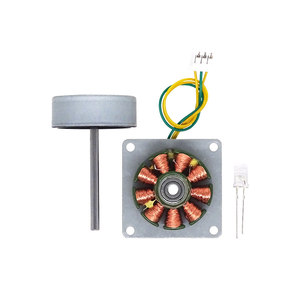
At the core of modern Chinese power storage micro-turbines lies high-grade NdFeB (Neodymium Iron Boron) rare-earth permanent magnets. Permanent Magnet Synchronous Generators eliminate the need for external rotor excitation power, delivering thermal efficiency levels over 92% across a broad rotational speed spectrum.
By pairing low-speed PMSG alternators directly with custom aerodynamic aerofoils (such as 3-blade HAWT or vertical axis helical designs), power systems capture energy at lower RPMs without thermal overload or acoustic noise pollution.
Maximum Power Point Tracking (MPPT) logic has evolved from simple linear curve matching to real-time high-frequency digital signal processor (DSP) tracking. Controllers continuously sweep the power curve of wind generators to extract peak output during turbulent or gusty wind scenarios.
A standard enterprise hybrid installation seamlessly routes multi-source input through intelligent switching nodes:
Combining two decades of direct-drive wind generator engineering heritage with world-class Chinese power storage manufacturing capabilities.
Founded with a singular engineering commitment to eliminate mechanical gearbox complexity. Our direct-drive wind energy systems have undergone rigorous field operations across demanding climates—from Scottish gales and Belgian coastal humidity to high-altitude North American feedyards.
Every generator, blade assembly, MPPT controller, and battery enclosure undergoes full factory load testing, high-pot insulation breakdown testing, dynamic rotor balancing, and environmental burn-in before export. Fully certified under CE, ISO9001, and IEC standards.
We provide comprehensive engineering services: site wind resource assessment, financial modeling (LCOE/LCOS), grid-interconnection clearance guidance, foundation structural drawings, installation supervision, and 24/7 remote SCADA portal monitoring.
Essential technical and economic guidance for purchasing managers, EPC contractors, and system integrators evaluating Chinese power storage solutions.
Horizontal Axis Turbines (HAWT) generally deliver higher aerodynamic efficiency (Betz limit efficiency up to 45%) and are ideal for open agricultural fields, rural campuses, and elevated tower mounts where wind flow is laminar. Vertical Axis Turbines (VAWT) excel in turbulent, multi-directional urban or rooftop environments, operate at lower RPMs with ultra-low noise signatures, and require minimal yaw adjustment.
As an initial screening standard, sites with an average annual wind speed of 4.5 m/s to 5.0 m/s (approx. 10–11 mph) at hub height yield positive financial returns. Selecting taller towers (e.g., 30m to 36m) allows the turbine rotor to access cleaner, faster laminar winds above surface obstacles (such as trees, barns, or silo structures), exponentially increasing annual energy production (AEP).
Gearboxes in small wind turbines are the primary cause of mechanical downtime, requiring routine oil changes, seal replacements, and gear wear O&M. Direct-drive permanent magnet generators connect the rotor blades directly to the alternator shaft. This eliminates friction losses, reduces total moving parts by over 60%, operates silently, and ensures a maintenance-friendly service life of 30 years with an availability rate exceeding 98%.
Solar energy generates exclusively during daylight hours, forcing standalone solar-plus-storage systems to oversized battery capacity to survive night-time cycles. Wind turbines frequently experience peak generation during night shifts and winter seasons. Co-locating wind generators fills the night-time charging curve, allowing developers to install smaller battery banks while achieving higher continuous power availability.
For seamless customs clearance and grid interconnection approval, verify that your OEM/ODM supplier provides CE certification (EMC & LVD directives), ISO9001 Quality Management accreditation, IEC 61400-2 compliance for small wind turbines, and UN38.3 / MSDS certificates for lithium battery energy storage transportation.
Yes. Our manufacturing facilities produce tailored alternator windings, custom rotor magnet assemblies, and multi-voltage smart MPPT controllers capable of matching off-grid low-voltage battery banks (12V/24V/48V DC) as well as commercial three-phase grid-tied systems (208V/380V/480V AC).
Need custom technical specifications, factory-direct OEM pricing, or a complete site-specific wind resource and battery storage assessment? Contact our global engineering team today.
