A wind solar hybrid storage system combines wind turbines, solar panels, batteries, and control equipment to supply electricity from changing resources. Wind may rise after sunset. Solar output peaks during daylight. Batteries store surplus power and release it when generation falls or demand climbs. In practical terms, a small site might pair rooftop panels with a turbine, battery cabinets, and an inverter beside its main electrical connection.
Renewable-energy advocate Hermann Scheer wrote, “The use of solar energy has not been opened up because the oil industry does not own the sun.” His words underline the value of locally available resources, though they do not address the engineering challenges of combining them. Those details matter. System performance depends on local wind and sunlight, battery capacity, equipment settings, and maintenance. A battery cannot compensate indefinitely for poor resource conditions or an undersized design.
Wind Solar Hybrid Storage Systems can improve supply reliability, but they are not automatic or identical solutions. Designers assess hourly weather patterns, expected electricity use, backup needs, and lifecycle costs before choosing equipment. A wind turbine’s output can vary sharply. So can cloud cover. Storage helps bridge some gaps, not every gap. Real projects also face trade-offs, including battery replacement and complex controls. The idea is promising, but the system still needs careful planning—and sometimes the first design needs rethinking.
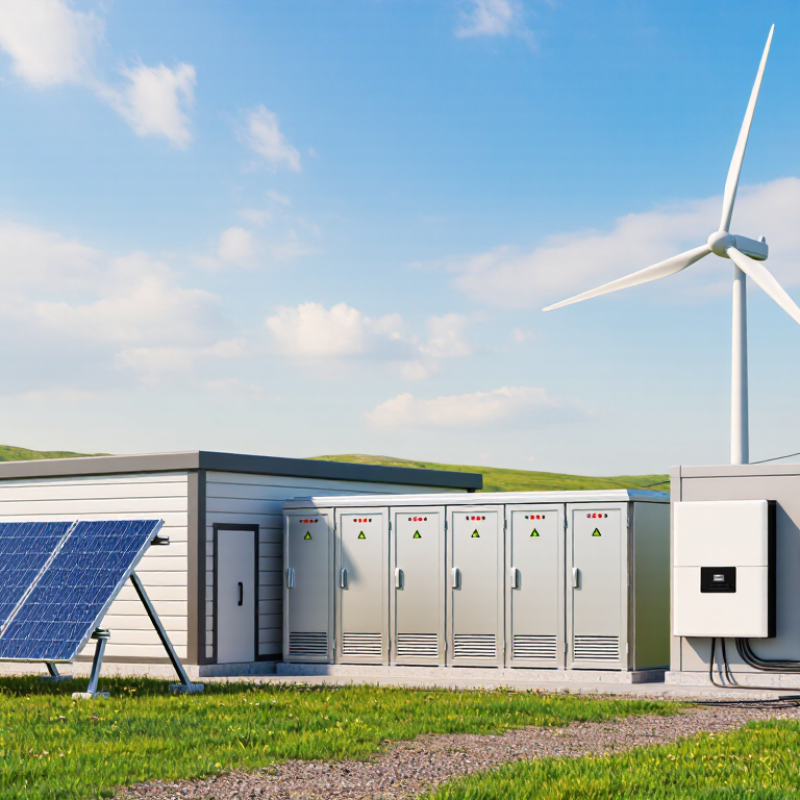
A wind–solar hybrid storage system combines wind turbines, solar panels, power electronics, and batteries to supply electricity from two renewable sources. The turbine converts moving air into electrical power, while photovoltaic panels produce power from sunlight. Their output varies with weather and time, so storage helps bridge gaps between generation and demand.
At the system level, controllers regulate wind and solar inputs. In a DC-coupled design, both sources feed a shared DC bus, which connects to a battery through suitable charge-control equipment. An inverter then converts stored DC electricity into AC for household or site loads. In an AC-coupled design, separate inverters connect generation sources to an AC bus, while a battery inverter manages charging and discharging. Battery management monitors conditions such as voltage and temperature. Exact equipment depends on the turbine, panel array, battery, and load profile. There is no universal layout.
Tips: Check the wind resource at hub height, not just ground level. Match battery capacity to typical overnight use, and allow for cloudy, calm periods. Small design details matter. A neat diagram may still miss cable losses or maintenance access; review these before installation.
What Is a Wind Solar Hybrid Storage System?
A wind-solar hybrid storage system pairs turbines and solar panels with batteries or other storage. Its value comes from different generation patterns. Solar output rises after sunrise, peaks around midday, and fades toward evening. Wind can continue after dark, though local weather matters.
The U.S. Energy Information Administration reported average 2023 capacity factors of about 23% for utility-scale solar and 34% for wind. These national averages describe energy production over time, not guaranteed output at any given hour.
Picture a battery charging from strong midday sunshine, then supplying a home when panels stop producing. If evening winds pick up, turbines may serve demand while preserving stored energy for calmer hours.
The timing is useful. Not perfect.
The National Renewable Energy Laboratory’s research on renewable integration emphasizes that variability depends on location, weather, and the mix of resources. A coastal site may see different wind patterns from an inland site, so combining technologies does not automatically eliminate supply gaps. Storage duration, transmission access, and hourly demand all shape performance. EIA’s annual averages help frame the opportunity, but project designers still need local, time-resolved generation data before estimating how reliably wind, solar, and storage can cover a 24-hour power profile.
A wind solar hybrid storage system combines turbines, photovoltaic panels, batteries, and power controls. The battery absorbs surplus electricity and releases it when sunlight fades or wind output drops. Storage duration usually ranges from one to eight hours, depending on the site’s load profile and renewable variability.
For example, a facility needing 500 kilowatts for four hours requires 2 megawatt-hours of delivered energy. At 90% round-trip efficiency, the battery may need about 2.22 megawatt-hours before adding operating reserves. Most modern systems achieve roughly 85–95% efficiency, but temperature, inverter losses, battery age, and charging speed affect actual performance. Usable capacity matters more than the nameplate rating.
Sizing requires hourly solar, wind, and load data across different seasons. A one-hour battery can handle short output changes, while an eight-hour system offers stronger support during prolonged low-generation periods. More duration is not always better. It can increase cost, space requirements, and replacement planning.
No spreadsheet predicts every calm night. A first estimate can be wrong. Field measurements and conservative assumptions improve reliability. Engineers should also review depth of discharge, emergency reserves, grid limits, and expected degradation. A practical design leaves room for unusual weather, because average conditions rarely tell the whole story.
What Is a Wind Solar Hybrid Storage System?
Energy Management: Forecasting, Dispatch, and Millisecond Grid Response
A wind solar hybrid storage system combines variable generation with battery storage and intelligent controls. Forecasting is its operating foundation. Weather models estimate wind speed, cloud movement, solar output, and local demand. The controller then compares predictions with live measurements every few seconds. The International Renewable Energy Agency reported that renewables added 473 gigawatts globally in 2023. Solar contributed about 75% of that growth, while wind contributed approximately 24%. More variable power requires better scheduling, not simply larger batteries.
Dispatch decisions should protect both reliability and battery life. The system may charge during midday solar peaks, then discharge after sunset. It can reserve capacity for sudden wind drops or transmission constraints. In the IEA’s Batteries and Secure Energy Transitions report, global energy storage capacity must increase sixfold by 2030. Millisecond inverter response can support frequency stability before slower generation reacts. That speed is valuable. Yet forecasts remain imperfect, especially during fast-moving storms. Operators should test forecast errors, state-of-charge limits, and communication failures.
Tips: Use rolling forecasts and conservative reserve margins. Measure forecast accuracy hourly, not only daily. Keep operating records for seasonal review. A simple dispatch rule may outperform a complex model when data quality is weak. Battery degradation also deserves honest attention; ignored cycling costs can distort project economics.
IRENA reported that the world added about 473 GW of renewable power capacity in 2023. That was a record increase, but growth was uneven across regions and technologies. Solar accounted for the largest share of new capacity, while wind also contributed substantially. The figure describes capacity added, not electricity generated. A new gigawatt on paper does not guarantee steady power at every hour.
That gap helps explain interest in wind solar hybrid storage systems. They combine wind turbines, solar panels, and batteries at one site or within a coordinated power system. When sunlight fades, wind may still produce electricity; when both sources dip, stored energy can help meet demand. The mix can smooth output, but it cannot erase weather variability. Batteries also have limited capacity, and their performance depends on sizing, operating conditions, and maintenance.
The 2023 expansion shows how quickly renewable infrastructure is growing. It also points to a practical challenge: connecting new capacity to grids that can use it reliably. A hybrid project needs careful assessment of local wind patterns, solar exposure, demand, and grid limits. Small details matter. A battery sized from annual averages alone may disappoint during a long, cloudy, still period. That part is easy to underestimate.
Industry context: Approximately 473 GW of renewable power capacity was added worldwide in 2023, strengthening the case for combining wind, solar, and energy storage to improve renewable power availability.
Global renewable power capacity additions in 2023 by technology, in gigawatts. Solar and wind accounted for the vast majority of new renewable capacity, while storage can help balance their variable generation.
It combines turbines, solar panels, batteries, and control software. Solar often peaks near midday. Wind may continue after sunset. The battery stores surplus electricity and releases it later. The pattern is useful, not perfect.
Solar can serve daytime loads and charge batteries. Evening wind may supply demand directly. Stored energy can cover calm periods. It varies locally.
Systems often use one to eight hours of storage. A 500-kilowatt load lasting four hours needs 2 megawatt-hours delivered. At 90% round-trip efficiency, about 2.22 megawatt-hours may be needed before reserves. Bigger is not always better.
Real performance depends on temperature, inverter losses, battery age, and charging speed. Usable capacity matters more than the nameplate number. Operating records reveal the difference.
Designers need hourly wind, solar, and load data across seasons. A one-hour battery may smooth brief changes. An eight-hour battery offers stronger support during long shortages. Average data alone can mislead.
Forecasts estimate wind, clouds, sunlight, and demand. Controllers compare forecasts with live measurements every few seconds. They may charge at noon and discharge after sunset. Simple rules can work better when data quality is weak.
Power inverters can respond within milliseconds. They may support frequency stability before slower generators react. Operators must still test communication failures and charge limits. Speed helps, but it does not create energy.
They should examine unusual weather, transmission limits, emergency reserves, and battery degradation. Forecast errors can grow during fast storms. No spreadsheet predicts every calm night. A first estimate may be wrong.
Wind Solar Hybrid Storage Systems combine wind turbines, solar photovoltaic generation, battery storage, power conversion equipment, and intelligent energy controls into one coordinated renewable power solution. Because wind output often increases during evenings, nights, or stormier periods while solar generation peaks during daylight, the two resources can complement each other across the 24-hour power profile. This reduces production gaps, improves renewable utilization, and supports a more stable electricity supply.
Battery capacity is commonly designed for approximately 1–8 hours of discharge, depending on demand patterns, grid requirements, and project economics. With round-trip efficiency typically ranging from 85% to 95%, the storage system can shift surplus energy, manage short-term fluctuations, and provide reliable backup. Advanced energy management systems use weather and generation forecasting to schedule charging and dispatch, while responding to grid changes within milliseconds. As global renewable capacity additions reached 473 GW in 2023, hybrid systems are becoming increasingly important for integrating variable renewable energy at scale.